GRIN: Inference for General Recognition Theory
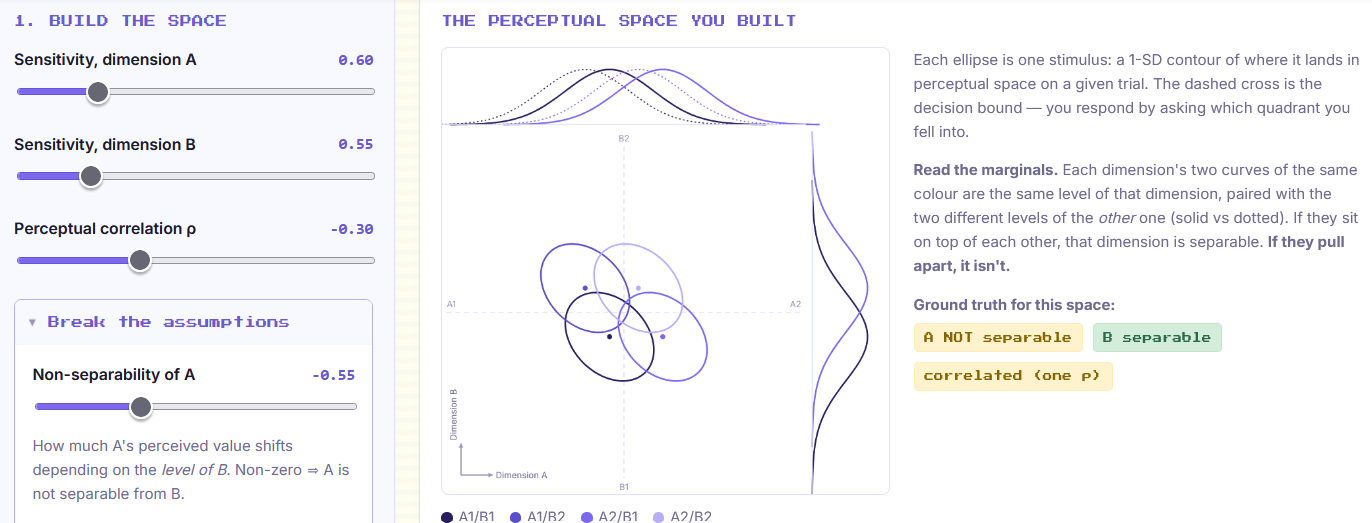
An implemented research tool uses simulation-based inference to estimate perceptual parameters from identification counts.
Fitting a theory of perception
General Recognition Theory describes how people identify stimuli that vary along more than one dimension. Fitting these models helps researchers examine perceptual interactions and distinguish them from decision processes.
Reusing simulation work
I develop GRIN, a research tool that trains neural networks on simulated experiments and uses them to estimate perceptual parameters and approximate posterior uncertainty from identification counts. Its validation work includes simulations with known parameters and comparisons with classical maximum-likelihood fitting.
What is available
The current tool supports count-based analyses and exploration of perceptual spaces. The project includes a browser interface and R/Python interfaces; the manuscript is being prepared for coauthor review.
Open GRIN for the tool, worked examples and validation evidence. Results should be interpreted within the model and training conditions documented there. Response-time inference is a developing extension and is not part of the current count-only capability.