Measuring Perceived Features of Melanoma Images
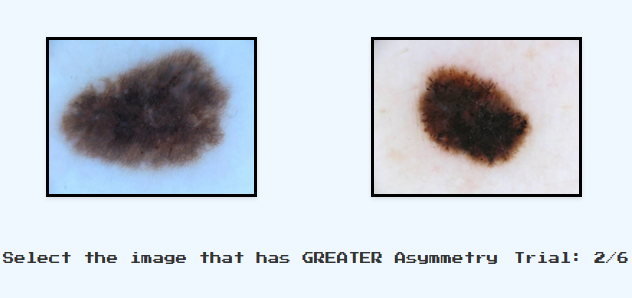
Pairwise judgments and a perceptual model provide human feature estimates that can be compared and combined with computer-vision measurements.
Measuring what an image looks like
Do human judgments of a skin lesion’s asymmetry, border and colour contain information that differs from computer-vision measurements? My postdoctoral research with Joseph Houpt and collaborators uses pairwise comparisons to investigate this question.
From comparisons to feature estimates
Participants compare images on a target feature. A Bradley–Terry–Luce model converts those judgments into relative feature estimates, which we compare with algorithmic measures and use in image-classification analyses. This connects a cognitive measurement problem with a practical classification task.
Findings and next questions
Combining human and computer-vision estimates improved classification within the image dataset compared with either source alone. That result supports studying their complementarity, while leaving open whether these measures improve clinical decisions or perceptual training.
A public preprint describes the work, and the manuscript is under review. The linked paper is distinct from the project’s materials repository. The study concerns image-based judgments and offline models, not a deployed diagnostic system.
Related Publications
- Bennett, M. S., Houpt, J. W., Townsend, J. T., Wenger, M. J., & Mark, L. (2026). Scalable estimation of continuous perceptual representations from human judgements and computer vision: An application to melanoma identification. Under Review. DOI